Introduction
This documentation covers the anynines Data Services Framework, which enables on-demand provisioning and full lifecycle management of Data Service Instances for application development teams.
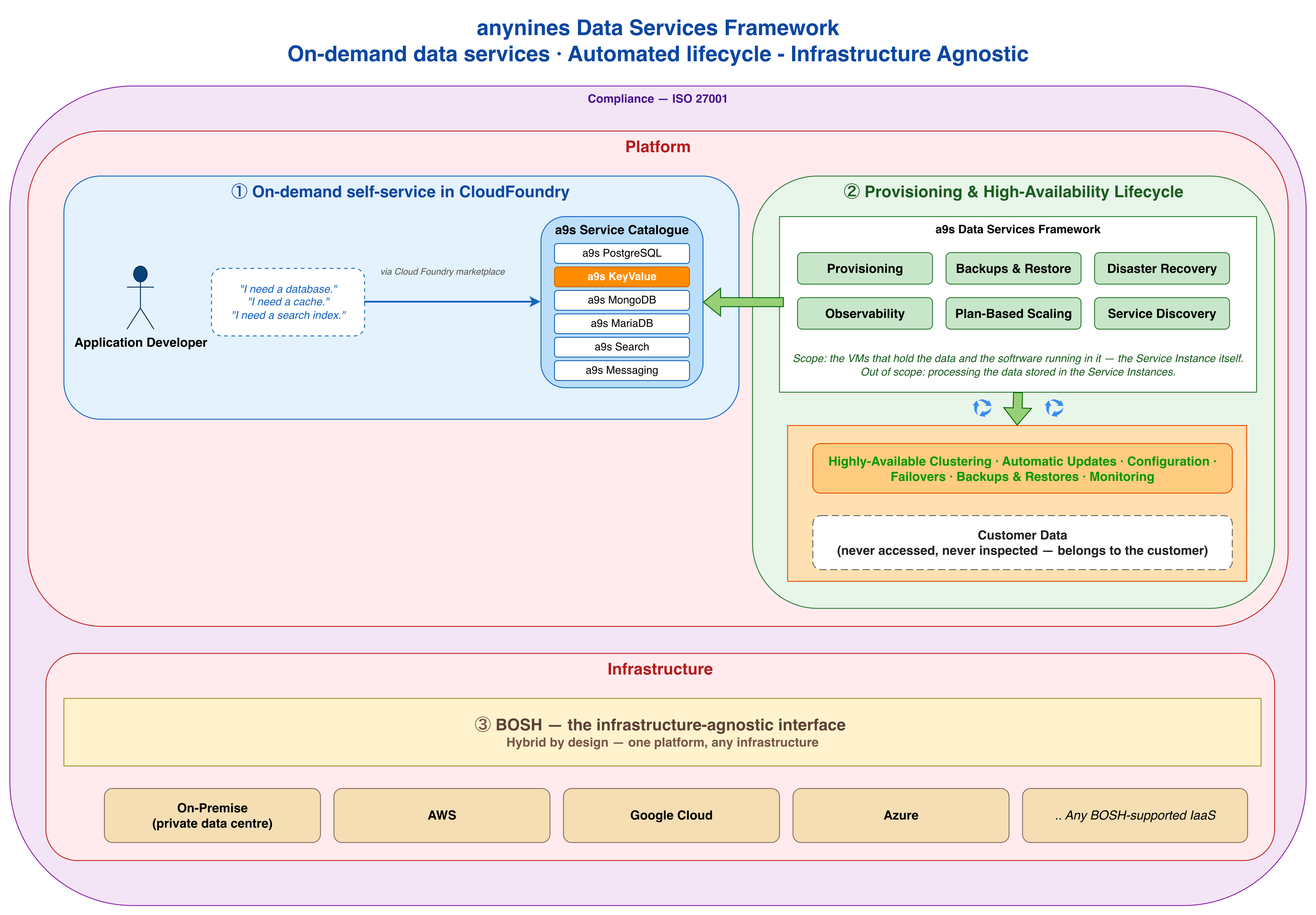
Through a self-service catalog, Data Service Instances are requested and delivered without requiring operational expertise from the consumer. The framework is infrastructure-agnostic and may be deployed on-premise or across public cloud providers, including AWS, Google Cloud, and Azure. The service catalog includes a9s PostgreSQL, a9s KeyValue, a9s MongoDB, a9s MariaDB, a9s Search, a9s Messaging, a9s LogMe2, and a9s Prometheus.
Key Concepts
The framework adopts the Open Service Broker API (OSBAPI) as its provisioning contract. OSBAPI is an open standard that defines how platforms request, manage, and consume services through a uniform API, making the framework compatible with any OSBAPI-compliant application platform.
The following concepts are central to working with the framework:
- Data Service: An atomic software system responsible for the on-demand provisioning, operation, and lifecycle management of services that handle data, such as databases, key-value stores, search engines, and messaging systems.
- Service Instance: A running, standalone instance provisioned by a Data Service on demand, based on a predefined Template. These could be, for example, a three-node, a9s PostgreSQL cluster or a single-node MongoDB database.
- Template: The deployment manifest used to provision a Service Instance. Templates define the topology (single node or cluster) and the set of processes that run inside the instance.
- Service Plan: Defines the size, topology, and capabilities of a Service Instance. A Plan references a Template and maps it to specific VM and disk types. Platform Operators define the available plans; Application Developers select from them when provisioning.
- Service Binding: A set of credentials and connection details that link an application to a specific Service Instance. Each binding is unique and may be revoked independently.
- Service Offering: A named Data Service available in the catalog, such as a9s PostgreSQL or a9s KeyValue. Each offering contains one or more Service Plans.
- Service Catalog: The full set of Service Offerings and their Service Plans announced by the framework to the platform (e.g. Cloud Foundry), causing it to populate its marketplace. Platform Operators configure the catalog to control which services and plans are available to Application Developers.
Core Capabilities
The framework provides, among others, the following core capabilities for each Service Instance:
- Provisioning and high availability
- Backup, restore, and disaster recovery
- Observability and monitoring
- Plan-based scaling and configuration
- Service discovery and automatic updates
Documentation Structure
This documentation is split into two sections.
The first section is for Application Developers. It describes everything an Application Developer might need to know to use the a9s Data Services.
The second section is the Platform Operator documentation. It describes everything a Platform Operator will need to know to deploy and operate the a9s Data Services Framework.